خرابگویی
What is a lisp?
A lisp is a Functional Speech Disorder (FSD), and a functional speech disorder is a difficulty learning to make a specific speech sound, or a few specific speech sounds.
The word 'functional' means that the cause of the disorder is not known. Indeed, in some literature FSDs are referred to as 'speech delay of unknown origin' or 'speech disorder of unknown origin'.
Functional speech disorders, or speech delays of unknown origin, may persist into adolescence and adulthood as 'residual errors'. They can be treated successfully in motivated children and adults.
Historically, FSDs were referred to as 'dyslalia' and within that category, difficulty saying /s/ and /z/ was called 'sigmatism'. These outdated terms are no longer used by SLPs/SLTs.
Where does the problem lie?

The speech difficulty in a child with a functional speech disorder is
probably at a phonetic level: that is, the child has a particular
difficulty producing certain sounds correctly. Alternatively, the child
has learned to say a sound, or sounds, the wrong way, and the incorrect
pronunciation has become a habit.
This is different from the situation of children with phonological disorders who can usually make the individual speech sounds, or be taught to reasonably easily, but have difficulties organising their speech sounds into a system of contrasts. Functional speech disorders are speech disorders, while phonological disorders are linguistic (language) disorders.
Co-occurrence
Functional speech disorders and phonological disorders can co-exist, so you might find a child with a developmental phonological disorder who also lisps. In other words, and rather more technically, phonetic and phonemic speech sound deviations can occur in the same individual.
'Lisping' - a 'lay' term
Problems saying 's', 'z, 'r', 'l' and 'th' are common in functional speech disorders. If they use the term at all, speech-language pathologists usually use the lay term 'lisp' to refer to a difficulty achieving the correct tongue position when pronouncing the /s/ and /z/ sounds. Some individuals, including some SLPs/SLTs, do not like the term lisp, perceiving it to carry a lot of baggage, and would prefer it not to be used in professional contexts.
Specifically, some people in the gay community object to the term lisp, especially when it is used in a pejorative, disparaging, belittling way. Some of these issues are touched upon in Beyond Lisping: Code Switching and Gay Speech Styles.
Characteristics of lisping
Typically, when a person lisps their tongue either protrudes between, or touches, their front teeth and the sound they make is more like a 'th' than a /s/ or /z/.
Protruding the tongue between the front teeth while attempting /s/ or /z/ is referred to as 'interdental' production, and touching the front teeth with the tongue while attempting to produce /s/ or /z/ is called 'dentalised' production.
There are two other types of lisp: the lateral lisp, and the palatal lisp. In a lateral lisp the person produces the 's' and 'z' sounds with the air escaping over the sides of the tongue, while in a palatal lisp they attempt to make the sounds with the tongue in contact with the palate. The four types of lisp are described in more detail below.
Is a lisp ever 'normal'?
It is a perfectly normal developmental phase for some (not all) children to produce interdental or dentalised /s/ and /z/ sounds until they are about 4½ years of age.
On the other hand, neither lateral or palatal lisps are part of the normal developmental progression.The speech of a child with a lateral or palatal lisp should be assessed, by a qualified speech-language pathologist/speech and language therapist, without delay.
Intelligibility
Lisping, as an isolated speech characteristic, does not usually reduce the person's intelligibility unduly. Most people can easily understand what the person with a lisp is saying.
Image
While there is usually little impact on intelligibility, the impact of a lisp on a child's 'image' can be quite powerful.
Of course, some children grow up in an environment where their lisp goes unnoticed, or where it is not regarded as cause for concern. Other children gain positive recognition because they lisp, particularly when the lisp is regarded as sweet, funny, or endearing.
By contrast, others face criticism, ridicule, nagging and teasing.
Grow up now
Sometimes children's lisps are regarded as cute until they reach a certain age at which time the same adults who have almost been encouraging them to lisp decide abruptly that it is high time they 'grew out of it'.
What can it be like for four and five year olds in this situation?
Four types of lisp
1. Interdental (frontal) lisp
In an interdental lisp (or frontal lisp) the tongue protrudes between the front teeth and the air-flow is directed forwards. The /s/ and /z/ sound like 'th'.
Children developing speech along typical lines may have interdental lisps until they are about 4½ - after which they disappear. If they don't 'disappear' an SLP/SLT assessment is indicated.
Interdental /s/
Words such as 'soup', 'missing' and 'pass', which all contain the voiceless alveolar fricative consonant /s/ are pronounced 'thoop', 'mithing' and 'path'. The voiceless 'th' sound that occurs in a word like 'thing' (or a sound very much like it) replaces the /s/.
Interdental /z/
Words like 'zoo', 'easy' and 'buzz' which all contain the voiced alveolar fricative consonant /z/ are pronounced 'thoo', 'eethee' and 'buth'. The voiced 'th' sound that occurs in a word like 'them' (or a sound very much like it) replaces the /z/.
2. 'Dentalised lisp'
'Dentalised lisp' is not an 'official' diagnostic term. It is an expression (like 'dentalised production') that SLPs/SLTs use to describe the way an individual is producing certain sounds. The tongue rests on, or pushes against, the front teeth, the air-flow is directed forwards, producing a slightly muffled sound.
Typically developing children (in terms of their speech) may produce dentalised variants of /s/ and /z/ until around 4½ years - and then grow out of it. If they don't grow out of it, an SLP/SLT assessment is indicated.
3. Lateral lisp
Lateral lisps are not found in typical speech development. The tongue position for a lateral lisp is very close to the normal position for /l/ and the sound is made with the air-flow directed over the sides of the tongue.
Because of the way it sounds, this sort of lisp is sometimes referred to as a 'slushy ess' or a 'slushy lisp'. A lateral lisp often sounds 'wet' or 'spitty'.
Unlike interdental and dentalised lisps, lateral lisps are not characteristic of normal development. An SLP/SLT assessment is indicated for anyone with a lateral lisp.
4. Palatal lisp
Palatal lisps are not found in typical speech development. Here, the mid-section of the tongue comes in contact with the soft palate, quite far back. If you try to produce a /ç/ - or a 'h' closely followed by a 'y', and prolong it, you more or less have the sound.
Unlike interdental and dentalised lisps, palatal lisps are not characteristic of normal development. An SLP/SLT assessment is indicated for anyone with a palatal lisp.
'sh', 'zh', 'ch', 'dj'
Sometimes children and adults who lisp when they attempt to say /s/ and /z/ also have tongue placement problems when they try to say 'sh' as in 'shoe', 'zh' as in measure, 'ch' as in 'chair', and 'dg' as in 'badge'.
They may dentalise these sounds, or produce them interdentally, or produce them with lateral air escape, or with excessive palate to tongue contact.
'...everything seems interdental'
Some children produce many sounds interdentally. Tongue protrusion, or very 'forward' or 'anterior' tongue placement may be observed when they say not only /s/, /z/, 'sh', 'zh', 'ch' and 'j', but also /n/, /l/ and other sounds.
In some children 'everything' seems interdental. This may sometimes be an indication that the nose is constantly obstructed, due for instance, to allergy, infection, large adenoids or craniofacial anomalies, or may be associated with habitual mouth breathing, tongue thrust, or sucking habits.
Waiting
Studies to confirm it are unavailable as far as I know, but I think most SLPs/SLTs would agree that in their clinical experience there is a greater likelihood that children will 'grow out of' interdental or dentalised lisps than lateral or palatal lisps.
I did a quick Web searchand found a lot of advice about lisping on the web - some of it very accurate and sensible. It worried me though, that many sites included the advice to wait until a child is 7 or 8 years of age before becoming concerned about lisping.
Waiting well past 4½ is not good advice. The longer the child waits the stronger any 'habit factor' will be. It is true that some children are not ready for therapy at 4½, but it is advisable to let a qualified SLP/SLT professional provide guidance in relation to the individual child, working on the results of face-to-face assessment.
The 'right' age for therapy for one child may be different from the "right" age for another, child even within the same family.
Referral and assessment
Young children are usually referred for assessment of lisps by their parents or caregivers, often on the advice of pre-school teachers.
It is, of course, uncommon for SLPs/SLTs to attempt to treat an interdental lisp, or dentalised production of /s/ and /z/, in children under 4½ years of age, because it is regarded as normal for them to produce the sounds that way.
They may, however, be interested in assessing children under 4½ who are reported to be lisping, in order to see whether it is a lisp, and, if so, what type of lisp it is.
Treatment for a lateral or palatal lisp may be appropriate in children under 4½.
Assessment
Assessment involves screening all areas of communicative function. The SLP/SLT takes a detailed history, examines the anatomy of the mouth and the movements it can make, checking for tongue tie, palate structure and function, swallowing patterns and so on. The clinician also takes a speech and language sample for analysis, and observes voice quality, fluency, and semantic and pragmatic skills skills.
Sometimes it may emerge that although a child is having difficulty saying /s/ and /z/, he or she is not actually lisping. These children may have some other speech sound disorder.
Omitting /s/ and /z/ (sun = un, tease = tee) or replacing them with consonants like /w/ or /d/ (sun = wun, so = doe) are not forms of lisping. Children with these sound replacements may be having phonological difficulties.
Intervention
Speech pathology intervention for lisps in young children is usually short-term and successful. Opinions vary among SLPs/SLTs with regard to how difficult or easy it is to help a child to overcome a lisp, and how long it will usually take.
Most SLPs/SLTs use a Traditional Articulation Therapy approach, or variations of it.
Example
Let's say that the client in the following example has an interdental lisp. In essence, his or her therapy will be like this:
- We will determine that the client can hear the difference between /s/ and 'th' as individual sounds, and in words (e.g., sink / think) using the Locke Task if necessary.
- We will provide auditory input.
- Using tactile, auditory and motoric cues we will teach the client to make the new /s/ sound.
- We will choose a word-position (let's say, for the sake of the example, that we choose the initial position).
- Using motor cues we teach the client to imitate and the produce independently /s/ in isolation
-
... in broken syllables
(s-oo s-ee s-or s-ie s-oh...) -
…in syllables
(soo see sor sie soh...) -
…in words
(Sue see saw sigh sew...sun sip soap...) -
…in phrases
(so silly, send sam, seven seals) -
…in sentences
(I see a sock...) -
…in controlled conversational contexts
(e.g., during dinner) - …in conversation
- …phasing out modelling and reinforcement
- ...and working towards self-monitoring and self-correction.
At each step in the process the client will practice under the supervision of an adult. Brief, frequent practice periods work best.
There is a good description of various approaches and techniques in Bernthal, Bankson and Flipsen Jr. (2009): Articulation and Phonological Disorders, 6th Ed.
The Butterfly Procedure can be an effective technique for remediating lateral or palatal production in children and adults.
Adults who lisp
Functional speech disorders, such as lisps, or difficulties saying /r/, /l/ or 'th' can persist into adulthood, especially in people who 'dropped out' of therapy as children, or who did not receive treatment.
 Some
adults who lisp have no desire to seek therapy and are happy to accept
their speech the way it is. There are many well known people (and a cat)
in public life, and some colourful characters who have 'trade-mark'
lisps as part of their image or persona.
Some
adults who lisp have no desire to seek therapy and are happy to accept
their speech the way it is. There are many well known people (and a cat)
in public life, and some colourful characters who have 'trade-mark'
lisps as part of their image or persona.
But there are also adults who lisp who are extremely unhappy about it. Some send email expressing frustration, embarrassment, and feelings of low self esteem and defeat.
They often fear that it may be 'too late' to change their speech, and many of them say that their lisp colours the way other people regard them. It is quite common, for example, for teenage boys and young men to tell me that people (incorrectly) assume that they are gay because they lisp.Does that suggest that to you that gay men who don't lisp are actually straight? I don't think so.
Assessment
Adults who lisp, and who do want help generally seek the help of a speech-language pathologist / speech and language therapist on their own behalf, often encouraged by a friend, family member, colleague or partner. The first step in the intervention process is an assessment by an SLP/SLT.
Intervention
Therapy for adults is along the same lines as therapy for children. Adults are usually very motivated to practice, but they sometimes find it difficult to find someone to help them with their 'homework'. It is vital to have someone to 'supervise' your practice, giving you accurate feedback, and encouragement, just as a parent would working with their own child.
Who can help?
The most effective way of managing a lisp is to seek the professional services of a SLP/SLT. Some adults like the idea of a do-it-yourself program, but there is no evidence reported in the research literature that these programs actually work.
Understanding Lateral Lisps
Posted by Jacky G. on Wednesday, May 2nd, 2012
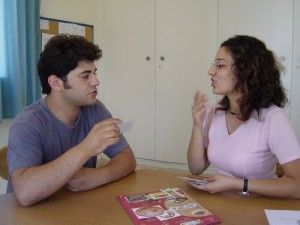
Image source: speechlanguagepathologyjobs.net
Some types of lisps (frontal and dentalized) can arise during normal development. This is not the case with lateral or palatal lisps. When vocalizing the “s” and “z” sounds, a child with a lateral lisp directs air flow over the sides of the tongue, rather than straight down the middle of the tongue. This is often a result of incorrect tongue placement. Speech-language pathologist (SLP) Caroline Bowen notes that children with a lateral lisp often use a tongue placement for the “s” and “z” sounds that is quite similar to the tongue placement for an “l” sound.
Identifying a Lateral Lisp
A lateral lisp is fairly easy for parents to identify because it results in the classic “slushy” sound. Listen closely to your child as he vocalizes sounds or words with the “s” and “z” sounds. If your child appears to have articulation difficulties, bring him to an SLP for an assessment. Treating a lateral lisp early can help your child learn proper speech patterns. Because a lateral lisp is not developmental it is critical to avoid waiting for the child to “grow out of it.”
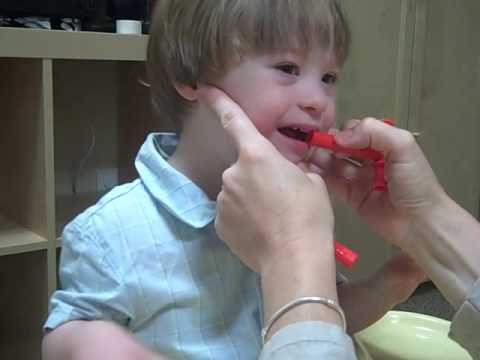
Image source: wn.com
Treating a Lateral Lisp
Your child’s speech therapist will likely begin treating a lateral lisp with auditory discrimination training. The speech therapist will help your child learn to discriminate between the proper and improper pronunciations of the “s” and “z” sounds. She will likely have your child work on articulating these phonemes by themselves. Your child will progress to articulating these sounds at the beginning, middle, and end of target words.
Your child’s SLP may also use tactile feedback to help your child with proper tongue positioning. Seal Speech Buddies provide a target in your child’s mouth so that he knows when his tongue is in the right place for proper articulation. You can also use Speech Buddies at home.

Image source: bookofodds.com
Activities at Home
In addition to the Seal Speech Buddy, you can do other activities at home to help encourage your child’s progress. Hold a feather in front of your child’s mouth and instruct him to blow air through the front of his mouth to move the feather. You can also play pretend games with your child to encourage proper air flow. Have him to pretend to pull a piece of string straight out of his mouth along the front teeth. Instruct your child to hiss like a snake while he does so. Every time you get your child a drink, give him a straw. Before giving him the drink, have him place the straw directly into the front of his mouth, underneath the front teeth. Encourage him to direct air flow into or along the straw.
Speech Buddies offers tools for parents and speech therapists to help children overcome speech disorders. Consider using Speech Buddies to make articulation practice fun and engaging for your child.
Understanding Palatal Lisps
Posted by Jacky G. on Tuesday, May 1st, 2012
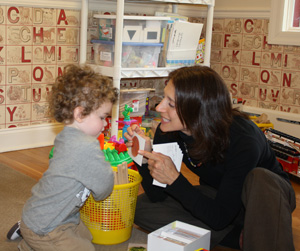
Image source: thechildwellnesscenter.com
Sometimes, a child can naturally “grow out of” a lisp. However, a palatal lisp is not a developmental problem, which means that your child is not likely to grow out of it. A palatal lisp occurs when your child touches the middle of his tongue to the soft palate when he pronounces the “s” and “z” sounds.
Identifying the Palatal Lisp
Parents can identify the palatal lisp by attempting to make the sound themselves. According to speech-language pathologist (SLP) Caroline Bowen, the sound of a person with a palatal lisp attempting to produce the “s” and “z” sounds will closely mimic the production of an “h” and a “y.” Try to make these two sounds close together and prolong the sounds. If your child has been making this sound, he may have a palatal lisp.
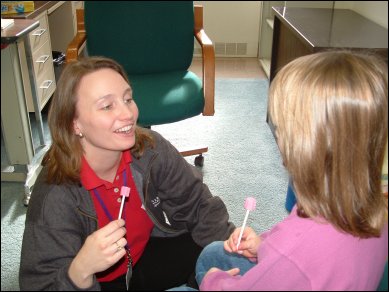
Image source: sw-rehab.org
Treating the Palatal Lisp
Taking the “wait and see” approach is not advisable with a palatal lisp. The longer your child continues to talk in this manner, the more difficult it can be to correct his speech. Bring your child to an SLP and have him evaluated as soon as possible.
Your child’s speech therapist might begin his treatment by helping him to differentiate between sounds so that he is aware of the correct pronunciation of the “s” and “z” sounds. She might also use the butterfly technique. The butterfly technique can help your child to visualize the correct placement of his tongue by imagining a butterfly. Your child will be asked to picture a butterfly while positioning his tongue so that the sides are slightly raised and lightly touch the teeth. The SLP will instruct your child to hold his tongue in this position while pronouncing the “s” and “z” sounds.
As your child masters the correct articulation of these sounds, his speech therapist will have him incorporate the sound into syllables and words. Your child will practice lists of target words with the “s” and “z” sounds in the beginning, middle, and ends of words.

Image source: besteducationpossible.blogspot.com
Activities at Home for Palatal Lisps
Talk to your child’s speech therapist about activities that you can do with him at home to accelerate his progress. She may provide you with lists of target words to work on together. Keep your child engaged by creating games around speech therapy. Sing the words together or play word guessing games. You can also use the Seal Speech Buddy with your child. This is a simple device that provides a target in your child’s mouth to facilitate correct articulation.
It’s always beneficial to read books together with your child. Reading them aloud models correct patterns of speech for him. If he’s old enough, encourage him to read them with you. Even if your child cannot yet read, he has likely memorized some short sentences from his favorite books.
 باسلام وخیرمقدم خدمت شماکاربرگرامی
0